2027 CNC Machining Manufacturers Outlook: Capacity Automation, Nearshoring Demand and Cost-Precision Tradeoffs
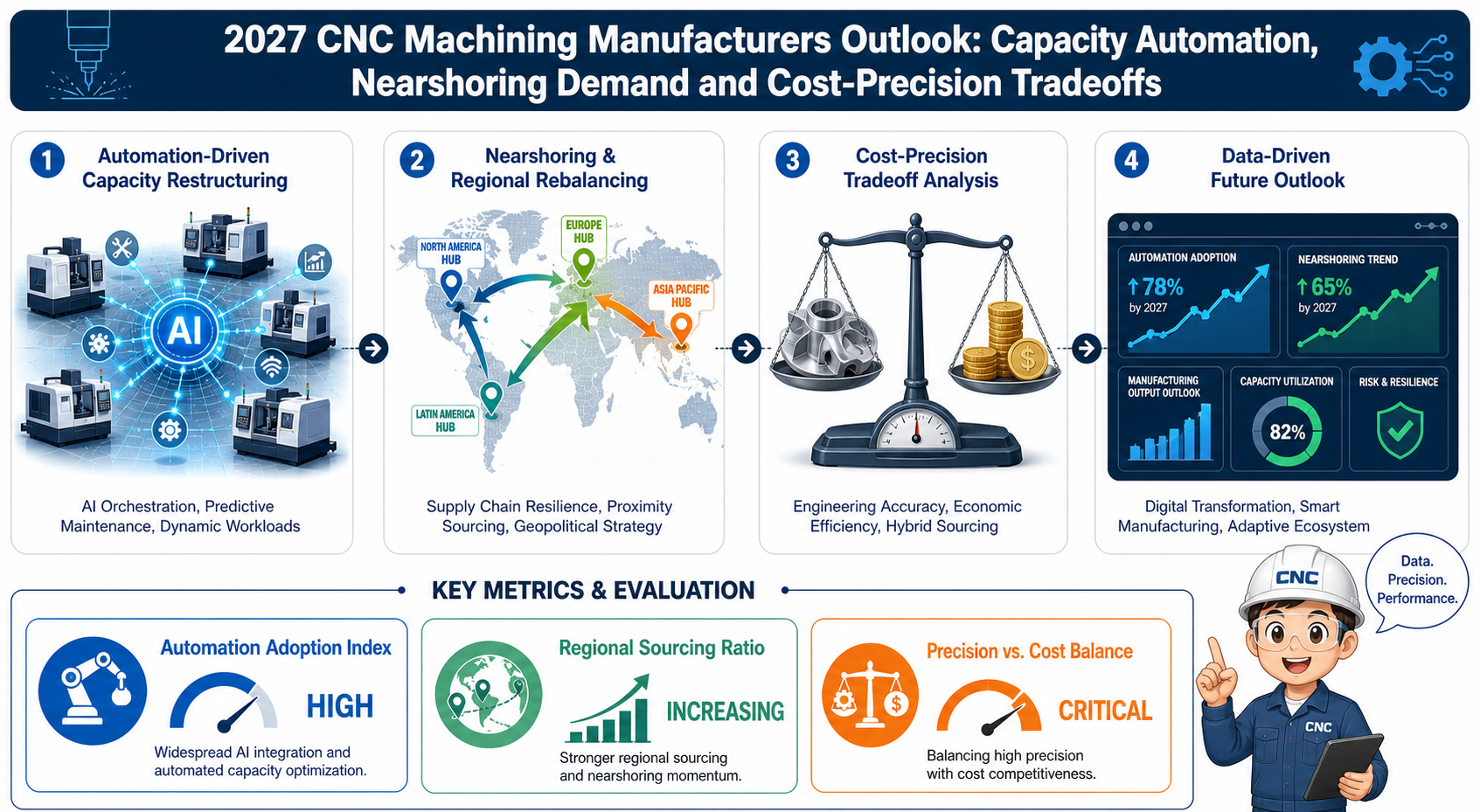
In 2027, the global landscape for CNC Machining manufacturers is being reshaped by a powerful convergence of automation acceleration, regionalized supply chains, and an increasingly delicate balance between cost efficiency and engineering precision. According to insights from industry research bodies such as McKinsey & Company and Gartner, advanced manufacturing is no longer just about production scale—it is about intelligent capacity orchestration.
For decision-makers, engineers, and supply chain strategists, 2027 represents a turning point: factories are becoming software-defined, sourcing is becoming geopolitical, and tolerances are becoming strategic assets rather than technical specifications. This article explores how these shifts redefine competitiveness in the CNC machining ecosystem globally.
Automation-Driven Capacity Restructuring in CNC Machining
From Machine Utilization to Intelligent Capacity Networks
The traditional model of fixed CNC machine utilization is rapidly evolving into distributed, AI-orchestrated production networks. Smart scheduling systems, predictive maintenance, and real-time workload balancing are enabling CNC facilities to dynamically adjust capacity across global nodes.
The trend is strongly driven by advances in industrial AI, robotics integration, and edge computing. According to McKinsey operations research, manufacturers adopting advanced automation can significantly improve throughput efficiency while reducing unplanned downtime.
Impact on value chain: Suppliers of raw materials face more synchronized demand cycles, manufacturers experience higher asset utilization, and customers benefit from shorter lead times but more dynamic pricing structures.
Nearshoring and Regional Manufacturing Rebalancing
Supply Chain Proximity Becomes a Strategic Asset
One of the strongest forces reshaping CNC machining networks is the shift toward nearshoring. Companies are re-evaluating global supply chains to reduce geopolitical exposure, transportation volatility, and lead-time uncertainty.
Research from World Economic Forum highlights that supply chain resilience has become a top-three priority for global manufacturers, especially in high-precision industries.
Impact on value chain: Regional suppliers gain pricing power, logistics providers pivot toward high-frequency short-haul networks, and OEMs increasingly dual-source CNC components across continents.
Cost–Precision Tradeoffs in High-Performance Machining
Engineering Accuracy vs. Economic Efficiency
CNC machining has always balanced precision and cost, but 2027 intensifies this tension. Ultra-tight tolerances required for aerospace, EV, and semiconductor industries are pushing manufacturers toward higher-grade machines, metrology systems, and quality assurance automation.
However, these upgrades introduce rising operational costs. As noted by Deloitte manufacturing insights, companies are increasingly adopting hybrid sourcing strategies—combining high-precision hubs with cost-optimized secondary production zones.
Impact on value chain: Design engineers must consider manufacturability earlier in product development, procurement teams must optimize supplier segmentation, and manufacturers must invest in flexible machining platforms.
| Factor | High Precision Strategy | Cost Optimization Strategy |
|---|---|---|
| Equipment | 5-axis CNC, AI metrology | 3-axis CNC, semi-automated QA |
| Cost Structure | High CapEx, high margin output | Low CapEx, volume-driven margins |
| Use Cases | Aerospace, medical devices | Consumer electronics, general parts |
Data-Driven Future Outlook for 2027
The CNC machining industry is expected to see continued digital transformation, with automation and regional diversification acting as dual growth engines. While exact forecasts vary across institutions, consensus indicates accelerating adoption of smart manufacturing systems worldwide.
| Trend | 2024 Baseline | 2027 Outlook |
|---|---|---|
| Automation Integration | Moderate adoption | High penetration across mid-to-large manufacturers |
| Nearshoring Activity | Early-stage restructuring | Mainstream dual-region sourcing model |
| Precision Demand | Industry-specific | Cross-industry requirement |
These trajectories suggest a manufacturing ecosystem that is more distributed, intelligent, and adaptive—though not without uncertainty in cost structures and regulatory environments.
Opportunities and Challenges for CNC Machining Manufacturers

Key Opportunities
- Expansion into regional manufacturing hubs driven by nearshoring demand
- Higher margins through advanced automation and smart factory integration
- New service models including rapid prototyping and digital twin machining
Key Challenges
- Rising capital investment requirements for advanced CNC systems
- Skill shortages in multi-axis machining and industrial AI operations
- Balancing cost efficiency with ultra-precision requirements
Practical Action Guide for Industry Stakeholders
- For strategic leaders: Invest in modular manufacturing networks and diversify regional production to reduce risk exposure.
- For operations managers: Implement predictive maintenance systems and integrate AI-based scheduling for CNC workloads.
- For general stakeholders: Focus on suppliers that offer both precision and scalability rather than purely cost-driven options.
How Trade Fuxing Demo Enables Competitive CNC Manufacturing
In this evolving environment, Trade Fuxing Demo supports CNC Machining manufacturers by aligning production flexibility with precision engineering needs. Through integrated sourcing capabilities and scalable production workflows, manufacturers can better respond to volatility in demand, cost pressures, and regional sourcing shifts.
To explore tailored CNC machining strategies or request a customized production consultation, you can contact our engineering team.
References and Industry Sources
- McKinsey & Company – Manufacturing & Operations Insights: Global analysis of automation and industrial transformation.
- Gartner Research: Technology trends in smart manufacturing and industrial AI.
- World Economic Forum: Supply chain resilience and regionalization studies.
- Deloitte Insights: Manufacturing cost structure and operational strategy research.

Get in touch with us!
and everything in between, our team of experts are always ready to assist.