Introduction: When Tooling Revisions Stall Industrial Sensor NPI Programs
For NPI engineers, mechanical leads, and procurement managers in industrial automation, few issues are more disruptive than repeated tooling revisions during sensor housing development. What begins as a seemingly minor connector mismatch or tolerance deviation often escalates into weeks of delayed pilot assembly and stalled validation cycles.
This article examines how a Plastic Injection Molding OEM approach—integrating DFM optimization, CNC bridge tooling, and rapid 3D-printed validation loops under a unified NPI Integration Blueprint—systematically eliminates iteration waste and restores predictable launch timelines.
The Real Cost of Tooling Revision Cycles in Sensor Housing Development
Industrial sensor housings require tight dimensional stability, connector alignment accuracy, and compliance with mechanical and electromagnetic standards. However, iterative mold modifications often introduce cascading delays across pilot builds, validation testing, and supply chain readiness.
| Pain Point | Operational Impact | Business Consequence |
|---|---|---|
| Repeated mold revisions | Interrupted pilot builds and rework loops | Extended time-to-market and missed launch windows |
| Connector fit uncertainty | Failed assembly validation checks | Increased engineering labor cost and scrap rate |
| Lack of early DFM alignment | Late-stage design corrections | Escalating tooling modification expenses |
| Slow prototype feedback cycles | Delayed decision-making | Reduced NPI throughput and ROI |
According to the International Organization for Standardization (ISO), manufacturing quality management inefficiencies remain one of the leading contributors to production variability in complex industrial systems. Similarly, NIST highlights that early-stage design errors can account for the majority of downstream production cost overruns in precision manufacturing environments.
Core Solution: Hybrid Plastic Injection Molding OEM with NPI Integration Blueprint
The proposed solution is a hybrid manufacturing model that merges high-fidelity DFM engineering, CNC bridge tooling, and rapid 3D-printed validation loops into a single synchronized workflow. This structure transforms tooling from a linear, revision-heavy process into a closed-loop validation system.
| Solution Layer | Function | Value Contribution |
|---|---|---|
| DFM Optimization | Early geometry and tolerance validation | Prevents downstream mold redesign cycles |
| CNC Bridge Tooling | Fast intermediate tooling for pilot builds | Enables stable assembly testing without full mold commitment |
| 3D Printed Fit Validation | Rapid connector and enclosure simulation | Reduces physical iteration cost and lead time |
| NPI Integration Blueprint | Unified workflow orchestration | Synchronizes engineering, tooling, and validation stages |
This approach aligns with standardized engineering validation principles outlined in ASTM International testing frameworks, where iterative validation reduces uncertainty in material and mechanical performance. It also reflects reliability engineering practices referenced by IEC standards for electronic and electromechanical assemblies.
How the Hybrid Loop Eliminates Revision Bottlenecks
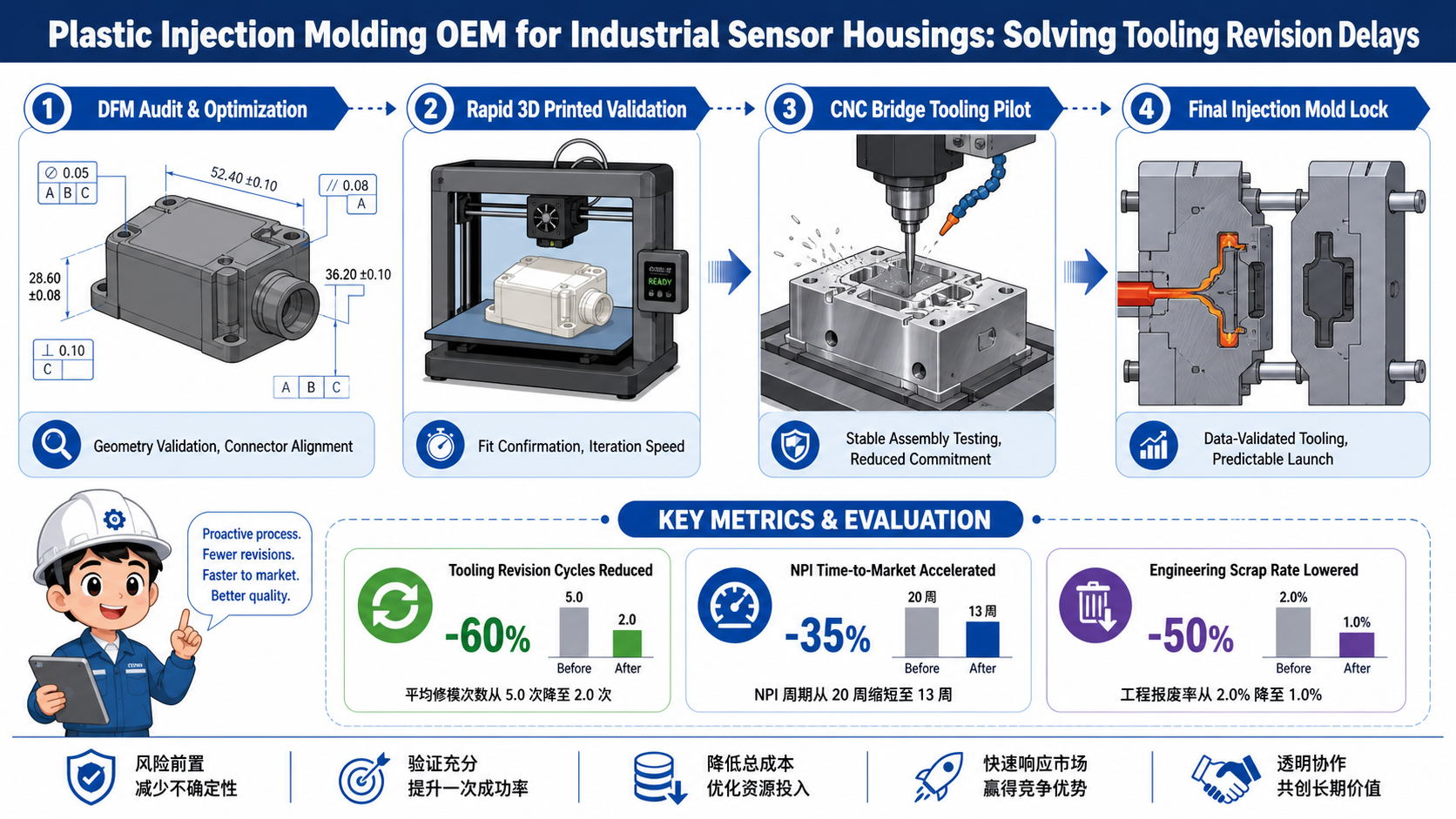
Instead of waiting for full injection molds before validation, the system introduces progressive fidelity stages:
1. Digital DFM simulation validates manufacturability
2. 3D printing confirms connector geometry and fit
3. CNC bridge tooling supports functional pilot assembly
4. Final injection tooling is locked only after validation convergence
This staged approach reduces the probability of late-stage mold rework while improving engineering confidence in dimensional stability and connector compatibility.
Effectiveness Support: Authoritative Principles and Systemic Coherence
The effectiveness of hybrid validation-driven manufacturing is supported by long-standing engineering quality frameworks. ISO 9001 quality management systems emphasize process control and continuous improvement, both of which are embedded in iterative DFM workflows.
In parallel, ASME mechanical engineering principles highlight the importance of tolerance stacking control and mechanical fit validation in precision assemblies, directly reinforcing the need for early connector fit verification.
From a materials performance perspective, standardized testing frameworks such as ASTM D standards ensure that polymer mechanical behavior is predictable under stress and environmental conditions, reducing uncertainty in housing durability.
System Synergy Model
The solution works as an interconnected system where each stage eliminates uncertainty before progressing to the next, ensuring tooling decisions are data-validated rather than assumption-driven.
Implementation Pathway: From Evaluation to Pilot Deployment
Industrial teams typically adopt this approach through phased integration:
- Stage 1: DFM audit of sensor housing geometry and connector interfaces
- Stage 2: 3D printed validation of critical fit zones
- Stage 3: CNC bridge tooling for pilot assembly trials
- Stage 4: Final injection mold commitment after convergence validation
Key questions procurement and engineering teams should ask include: How early are connector tolerances validated? How quickly can design iterations be reflected in physical prototypes? What is the expected tooling revision cycle reduction rate?
A structured OEM partner typically provides integrated support across these stages, ensuring rapid iteration cycles and reduced engineering friction.
Conclusion: From Iteration Chaos to Predictable Manufacturing Flow
Tooling revision delays in industrial sensor housing programs are not merely technical inefficiencies—they are systemic NPI bottlenecks that increase cost, delay revenue, and reduce engineering bandwidth. A hybrid Plastic Injection Molding OEM model that combines DFM optimization, CNC bridge tooling, and 3D validation loops provides a deterministic path toward predictable launch execution.
By aligning engineering validation with manufacturing readiness, organizations gain a repeatable framework for accelerating industrial sensor deployment while minimizing revision risk. Partnering with a capable OEM ensures this system is not theoretical, but operational at scale.
To explore how this integrated NPI approach can be applied to your sensor housing program, engage with an engineering team through solution consultation and NPI assessment.